"use client" Creep: How Our Server-First App Quietly Became a 1.2MB SPA

No one on the team ever proposed shipping 1.2MB of JavaScript to render a mostly-static customer portal. There was no meeting where we decided that. It happened the way most architectural erosion happens: one reasonable-looking "use client" at a time.
How creep happens: the four ratchets
Watching that history unfold in the git log, the additions clustered into four recurring moves — each locally sensible, each ratcheting the boundary upward.
Ratchet 1: the error-message shortcut. You hit useState is not defined in Server Components or the function-prop serialization error, and the fastest green build is "use client" at the top of the current file — which is often a section or layout, not the button that needed it.
Ratchet 2: the shared-file trap. Someone adds a usePathname() call to a utility component in components/shared/. Every server component importing anything from that barrel file now pulls a client module — and because the directive is transitive through imports, whole subtrees silently switch sides.
Ratchet 3: the library import. A dev imports a chart library, a date picker, an animation lib — client-only, hooks inside — into an otherwise-server page, then marks the page client to make it compile.
Ratchet 4: copy-paste inheritance. New files start as copies of old files. If the template file has the directive, its descendants do too, needed or not. Eleven of our 74 directives had no client-only APIs in the file at all.
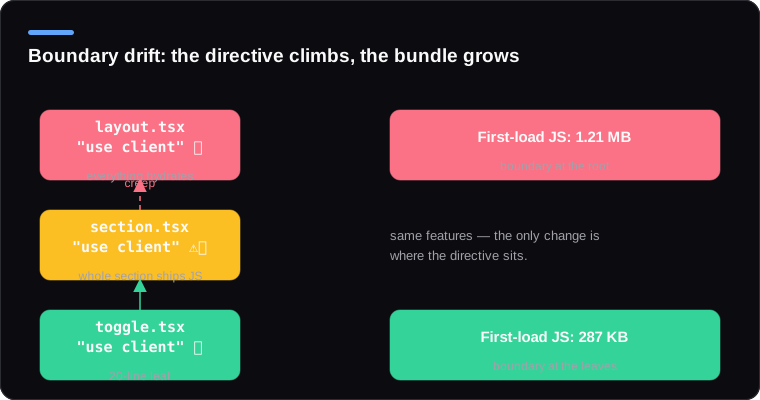
Why this costs more than kilobytes
The bundle size is the visible symptom, but the deeper losses compound:
- Data fetching moves client-side. Components that cross the boundary can't be async, can't touch the database, can't read secrets — so fetching migrates into effects and route handlers, resurrecting the waterfalls and loading spinners App Router was adopted to kill.
- Everything hydrates. Server-rendered HTML for a client component still ships its JS and re-executes on the client. A megabyte of hydration on mid-tier mobile hardware was ~1.9s of main-thread time in our traces — that was the Lighthouse regression, not network.
- The boundary stops meaning anything. When 90% of the tree is client, "is this safe to put secrets/queries in?" has no quick answer, and review burden goes up everywhere.
Reversing it: the mechanical part
The cleanup was less clever than you'd hope, which is the good news — it's repeatable.
Step 1: find directives that do nothing. We scripted it: for each file with the directive, grep for client-only signals (useState, useEffect, event handlers, window, browser APIs). No hits → remove the directive, run the build. Eleven directives deleted in an afternoon.
Step 2: push the rest toward the leaves. For each remaining boundary, extract the interactive core into its own small file and un-mark the parent:
// Before: entire 400-line PortfolioSection is client for one toggle
"use client";
export function PortfolioSection({ holdings }: Props) { /* ... */ }

// After: server section, client leaf
// portfolio-section.tsx (server — data, layout, 390 lines)
export async function PortfolioSection({ accountId }: Props) {
  const holdings = await getHoldings(accountId);
  return (
    <section>
      <HoldingsTable holdings={holdings} />
      <CurrencyToggle /> {/* the only client bit */}
    </section>
  );
}

// currency-toggle.tsx (client — 20 lines)
"use client";
export function CurrencyToggle() {
  const [ccy, setCcy] = useState<"CAD" | "USD">("CAD");
  // ...
}
Step 3: break the shared-barrel contagion. Split components/shared/index.ts exports so server-safe and client modules don't travel together. A barrel file that re-exports one client component clientifies every consumer of the barrel.
Step 4: use the children pass-through for client shells that wrap server content (context providers, animation wrappers, collapsibles) — the pattern I covered in the RSC boundary post. Providers were our biggest single win: the theme + analytics provider stack at the root had been marking everything below it as its import graph; restructured to accept children, the tree below went back to being server-rendered.
Keeping it reversed: the ratchet in the other direction
Erosion resists one-time fixes, so the durable half of the engagement was CI:
// budget checked in CI against the build manifest
{ "route": "/portfolio", "maxFirstLoadKB": 220 }
Plus one process rule — any PR adding "use client" states in its description which browser API or hook requires it. Not approval theatre; just forcing the one-sentence justification that distinguishes ratchet 1 from a real need.
Eight weeks later: first-load JS 287KB (from 1.21MB), mobile LCP down 41%, and — my favourite metric — data fetching back in server components, which deleted about 900 lines of loading-state boilerplate.
The git log now shows directives being removed in ordinary feature PRs — the team's default flipped back. Architecture is what the defaults do when nobody's watching.
Keep Reading
10 Jul 2026
The Dashboard That Died Every Night: Hunting React Memory Leaks
09 Jul 2026
Maximum Update Depth Exceeded: A Field Guide to Infinite Render Loops
13 Jul 2026
The useEffect Chain Reaction: Derived State and the Effects You Don't Need
12 Jul 2026
Streaming That Doesn't Stream: Fixing Suspense Waterfalls in Next.js